
FZI and DFKI Are Developing New Approaches for Resilient Communication in Crisis Situations
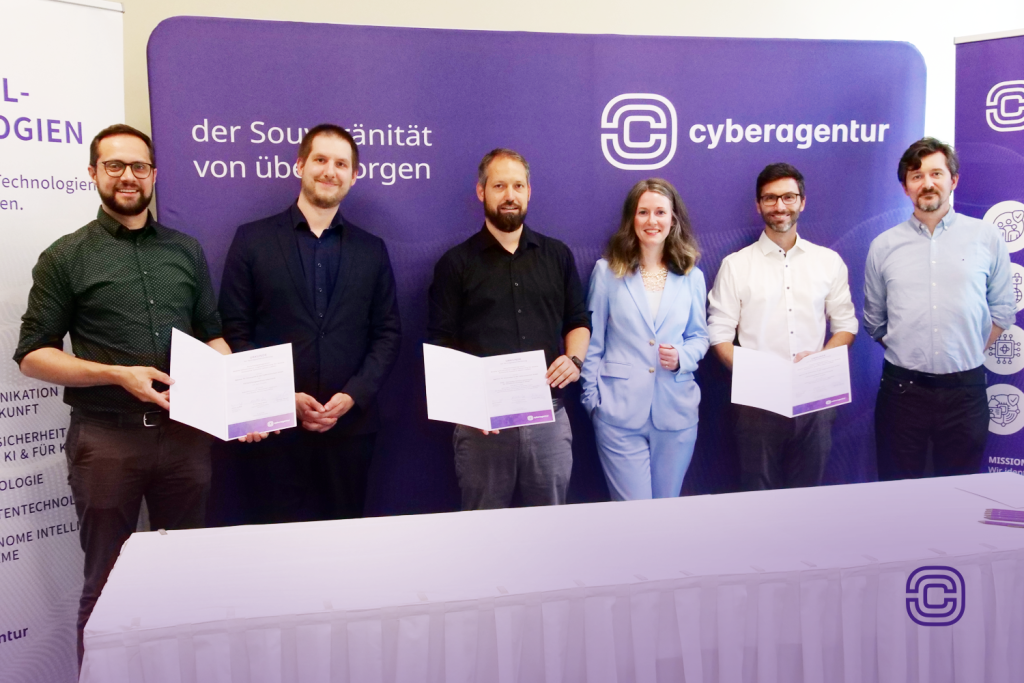
On July 9, 2026, the Agentur für Innovation in der Cybersicherheit GmbH (Cyberagentur), together with the FZI Research Center for Information Technology and the German Research Center for Artificial Intelligence (DFKI), officially launched the research phase of the MoIn-LaMAS program. The aim is to develop autonomous robotic systems that can independently establish and maintain a resilient communications infrastructure in crisis situations.
The Launch of a New Generation of Autonomous Communications Infrastructures
With the signing of the project agreements on July 9, 2026, the Cyberagentur officially launched the research phase of its MoIn-LaMAS research program—Mobile Infrastructure: Situational Awareness for Mobile Autonomous Systems. Together with two high-caliber research partners, the goal over the next two years is to develop technologies capable of establishing and maintaining stable communication networks even in areas where existing infrastructure has failed or is nonexistent.
On behalf of the Cyberagentur, the documents were signed by Commercial Managing Director Bettina Bubnys and Dr. Eva-Maria Heinke, Head of the Unmanned Systems and Robotics Division. Signing on behalf of the research partners were Johannes Mangler, Technical Project Manager of the FZI project R.O.A.M. —Robot Teams for Autonomous Situational Awareness and Mobile Ad-hoc Networks—and Dr.-Ing. Malte Wirkus, project manager of the DFKI project ART-LaKo—Autonomous Robot Team for Creating and Maintaining Situational Awareness and a Communication Infrastructure in Crisis Situations.
The aim is to develop a demonstrator that proves the practical feasibility of the technologies under realistic operating conditions.
Communication Becomes Part of the Autonomous Situational Picture
MoIn-LaMAS takes a research approach that differs significantly from existing work in the fields of autonomous robotics and mobile communication networks. While many international research projects treat navigation, coordinated control, and wireless communication as separate areas, MoIn-LaMAS combines these disciplines into a single, integrated system.
The focus is on developing autonomous systems that not only sense their environment but also simultaneously evaluate the quality of communication links and adjust their positions accordingly. Factors such as radio range, bandwidth, interference, and terrain profiles become part of the digital situational picture. Based on this, the systems autonomously decide how communication nodes should be optimally distributed or relocated.
As a result, communication itself becomes a crucial source of information for autonomous decision-making.
Heterogeneous robot networks create resilient networks
Another key area of research focuses on the collaboration between different autonomous platforms. Airborne and ground-based systems together form a heterogeneous network capable of flexibly establishing, expanding, and reconfiguring communication networks.
This creates a mobile infrastructure that continuously adapts to changing operational conditions. If a communication node fails or the situation changes, the network automatically reorganizes itself. This approach increases resilience to failures and enables communication links even in hard-to-reach or heavily disrupted operational areas.
The expected research results hold significant potential for innovation, particularly in the areas of civil protection, disaster management, and border security.
“With MoIn-LaMAS, we are researching technologies that not only replace communication infrastructures but can also autonomously build and maintain them under dynamic conditions. The combination of robotics, artificial intelligence, and communication opens up entirely new possibilities for future application scenarios,” says Thilo Behrendt, program director at the Cyberagentur.
Two Research Approaches Toward a Common Aim
The two selected research projects take different scientific approaches and complement each other.
Through its R.O.A.M. project, the FZI Research Center for Information Technology is developing methods for autonomous robot teams that generate situational awareness and establish mobile ad hoc communication networks.
Through ART-LaKo, the German Research Center for Artificial Intelligence (DFKI) is conducting research on autonomous robotic systems that simultaneously generate situational awareness and maintain communication infrastructures in dynamic crisis scenarios.
Both projects thus make a significant contribution to the development of future key technologies for resilient and adaptive communications infrastructure under demanding operating conditions.