
Podcast episode sheds light on quantum computing, cryptography and their social explosive power
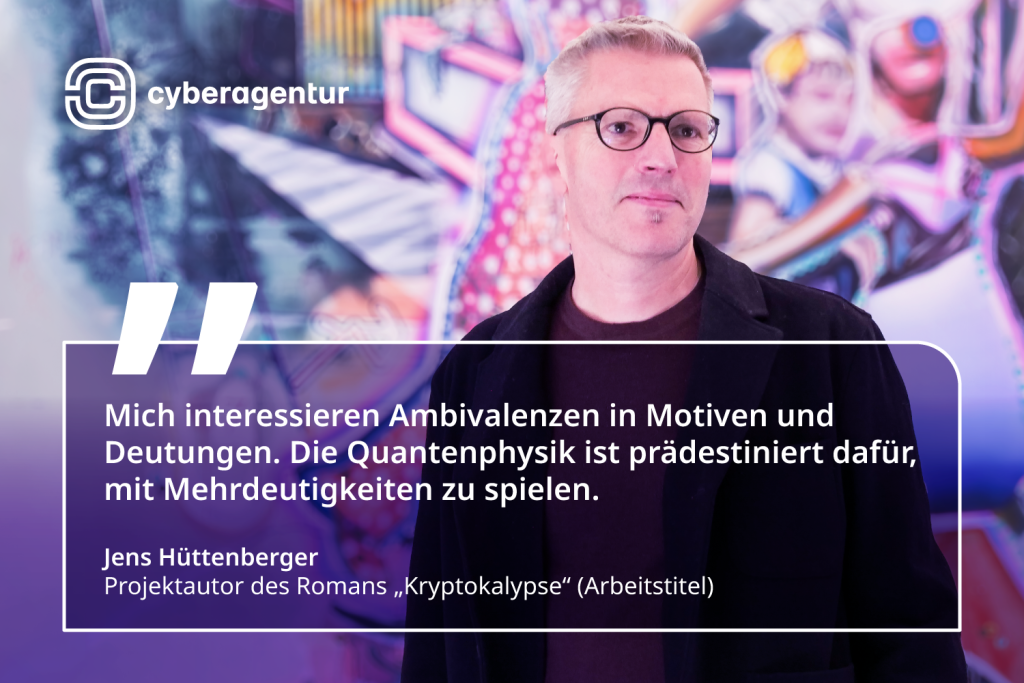
What happens when a publicly accessible quantum computer recalculates the world? The Agentur für Innovation in der Cybersicherheit GmbH (Cyberagentur) answers this question with an unusual means: a science fiction novel. On April 9, 2026, author Jens Hüttenberger explains in the podcast “Hitchhiking through cyberspace” why the federal government’s in-house company let him take up the pen and what quantum technology has to do with our everyday lives.
A unique project in the German government landscape
Federal institutions communicate in reports, situation reports and press releases. The Cyberagentur is now taking a new approach: it is having a novel written. “Kryptokalypse” is a near-future novel dedicated to the question of what social, economic and security policy consequences powerful quantum computers could have. The project is unique in this form in the German federal agency landscape.
In the Cyberagentur podcast “Hitchhiking through cyberspace” on April 9, 2026, host Marcel Roth talks to author Jens Hüttenberger about the genesis, aim and depth of content of the project.
Jens Hüttenberger has been a member of the Cyberagentur’s innovation management team since the beginning of 2026 and is writing the novel as part of this role. He is therefore not only the author, but also part of the interdisciplinary team that scientifically underpins the content of the book.
2039: A machine that recalculates the world
Set in the year 2039, the fictional company QuaaSE has launched the first publicly accessible ion quantum computer with 100,000 qubits as a quantum-as-a-service. Pharmaceutical companies, logisticians, materials researchers and research institutes buy time slots to use the previously unthinkable computing power.
At the center are two women with opposing perspectives: Anaram, a physicist and logistics consultant, sees quantum technology as a historic opportunity for more efficient supply chains and new trade alliances. Alice, mathematician and post-quantum cryptographer, knows the downsides: Common encryption methods are vulnerable to attack by powerful quantum computers. The so-called Q-Day – the day on which security keys are decoded and financial transactions, internet connections and communication systems are exposed – is no longer a dystopia, but a calculable risk.
Alice also sees social distortions: more global trade means more CO₂ emissions, growing inequality between those who have access to quantum computers and those at the other end of the supply chain. This conviction turns her into a hacktivist – with unexpected consequences that the book leaves open until the last page.
Why a novel? Science needs a narrative
The idea of communicating complex technology topics through literature is not an invention of the Cyberagentur – but its consistent institutional implementation is. Companies such as Intel, Audi and SAP have been using science fiction for years to stimulate innovation processes. Military think tanks such as the US Army Mad Scientist Program specifically rely on speculative fiction to play out future scenarios. In Germany, a comparable project by a federal authority was previously unknown.
The aim of the Cyberagentur is to make cyber security-relevant future topics accessible to a broad public – beyond specialist publications and status reports. Quantum computing and cryptology are among the most strategically significant technologies of our time. At the same time, citizens use cryptological procedures dozens to hundreds of times a day: when accessing websites, when banking online, with every encrypted message. The gap between social relevance and public awareness is enormous. “Cryptocalypse” aims to close it.
Interdisciplinary substance
A particular quality feature of the project is the close cooperation with the Cyberagentur’s scientific staff. Cryptologists, quantum physicists, AI experts, political scientists, futurologists, criminologists and lawyers contribute their perspectives. The result is a novel that works as literature and is scientifically robust – readable without prior knowledge and without simplifying the content.
In literary terms, the text takes up the parallelism of quantum mechanics and plays with the ambiguity of quanta – a structure that, according to Hüttenberger, is not just formal but also substantive: Hope and threat, progress and loss of control exist simultaneously in the novel.
Podcast episode from April 9, 2026
In the new episode of “The Hitchhiker’s Guide to Cyberspace”, presenter Marcel Roth asks the author about his work: How is a scientifically sound novel created within a federal authority? What freedoms does literature have that a technical report does not? And what makes quantum computing a threat – and an opportunity at the same time?
The podcast will be available on all common platforms from April 9, 2026.
About the author: Jens Hüttenberger
Jens Hüttenberger, born in Bonn, has been working as a copywriter and author for more than 25 years. After studying African Studies, Philosophy and Ethnology (M. A.), he worked in two advertising agencies for nine years before setting up his own business. His awards include the “German Prize for Online Communication 2023” and a nomination in the “Year of Advertising”.
He has published several books, including “Würgenberg – Weintrips zwischen Mecker und Ödwald” (KVB Verlag), the crime novels “Das Paraklet-Gesetz” and “Muskelspiele” (under the pseudonym J. P. Büttner) as well as – unpublished – “Die Antwort”. In his works, he combines narrative power with philosophical reflection and humor.
Jens Hüttenberger has been a member of the innovation management team at the Agentur für Innovation in der Cybersicherheit GmbH since the beginning of 2026. “Kryptokalypse” was created as part of this work in close cooperation with the Cyberagentur’s scientists.
Further information and registration: