
Cyberagentur launches a call for interest in the planned tender “EU-Autark” with the goal to reduce critical raw material dependencies in computers, electronics, electro-optics, electromechanics and electrical engineering
Agentur für Innovation in der Cybersicherheit GmbH (Cyberagentur) is preparing a new research program! “EU-Autark” aims to reduce Europe’s dependence on raw materials and thus its vulnerability. An informal call for interest (https://ted.europa.eu/de/notice/-/detail/5158-2026) has been issued to research institutions and companies, inviting them to identify key capabilities and propose innovative materials, components and production processes that will enhance the resilience and geopolitically independence of these capabilities.
Europe is at a technological turning point: shaping a sovereign digital future requires the independence of key technologies from critical raw materials that are susceptible to geopolitical influences. The “EU-Autark” program addresses precisely this issue – research-driven, security-oriented and strategically necessary.
To prepare the research program “EU-Autark” the Cyberagentur is launching the informal call for interest. Goal of the research program is to significantly reduce Europe’s dependence on critical raw materials (CRM). This will strengthen Europe’s digital sovereignty in the long term. The importance of “EU-Autark” is clear: geopolitical tensions are already leading to bottlenecks and price spikes. In an emergency, critical key technologies that depend on these raw materials cannot be adequately supplied.
Critical raw materials are indispensable for key basic technologies ranging from sputter targets used in chip manufacturing to optical amplifiers used for global internet communication. However, many of these materials come from politically unstable regions or are controlled by a small number of suppliers. The European Union classifies them as particularly relevant to security due to their economic benefits and supply risks. For Europe, this transforms the issue of technological capability into one of strategic dependence.
“EU-Autark” addresses this problem on the technological side: novel materials, components and production processes that require no or significantly less CRM are intended to decouple key capabilities from raw material availability. The Cyberagentur focuses on computers, electronics, electro-optics, electromechanics and electrical engineering, i.e. NACE classes C26 and C27. Europe’s autonomy in these technologies determines its strategic scope for the future – from photonic infrastructure and microelectronic components to energy and signal transmission systems.
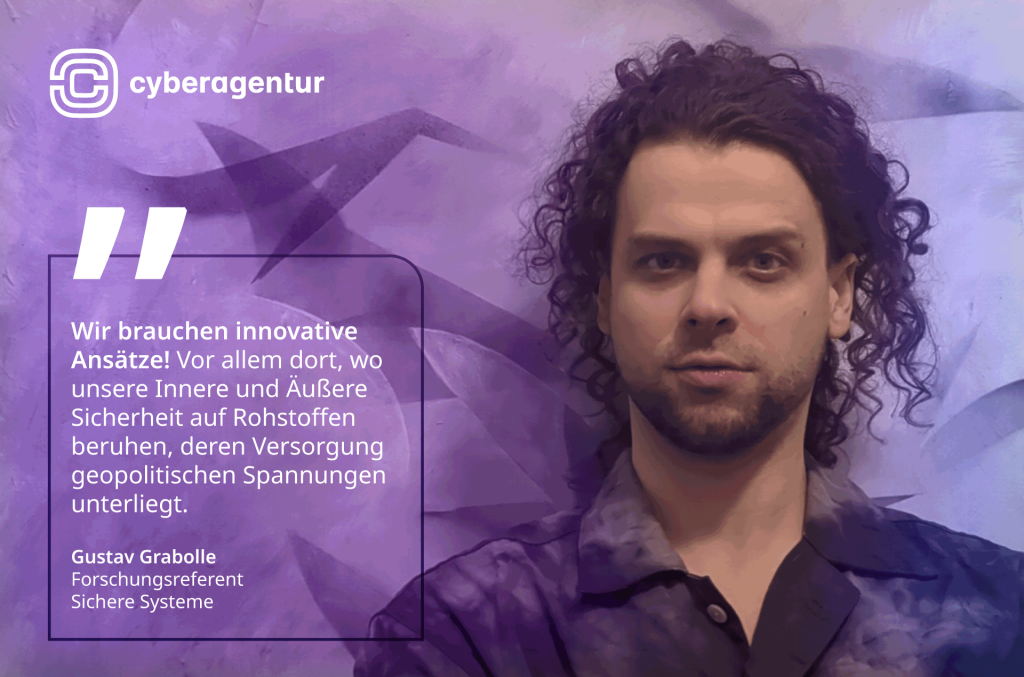
Gustav Grabolle, research officer in the “Secure Systems” department and the “EU-Autark” contact person, sums up the security policy dimension: ‘We need innovations! This is particularly pertinent when our internal and external security hinges on raw materials whose supply is subject to geopolitical tensions.’
The process invites broad participation from the research community: academia, industry and specialised SMEs can submit outlines of ideas that identify critical capabilities, analyse existing technical approaches and propose novel solutions. The scope is deliberately kept open, ranging from alternative functional materials for microelectronics to new photonic processes and completely new production principles.
The outlines submitted are intended to help tailor the final tender to technological feasibility, industrial relevance and Europe’s strategic needs. In this way, the Cyberagentur allows for an early participation in the design of the tender such that research will focus precisely on areas where Europe is most vulnerable.
The call for tenders was published in the Supplement to the Official Journal of the European Union under contract notice number TED 5158-2026 (https://ted.europa.eu/de/notice/-/detail/5158-2026). Interested participants can submit their ideas electronically by 1 February 2026 via: https://forms.office.com/e/Jg77QX1JAA Questions about the procedure can be sent to: eu-autark-ibv@cyberagentur.de Please submit any questions by 25 January 2026 at the latest to ensure a timely response.