
Three Paths to a Mobile Quantum Computer
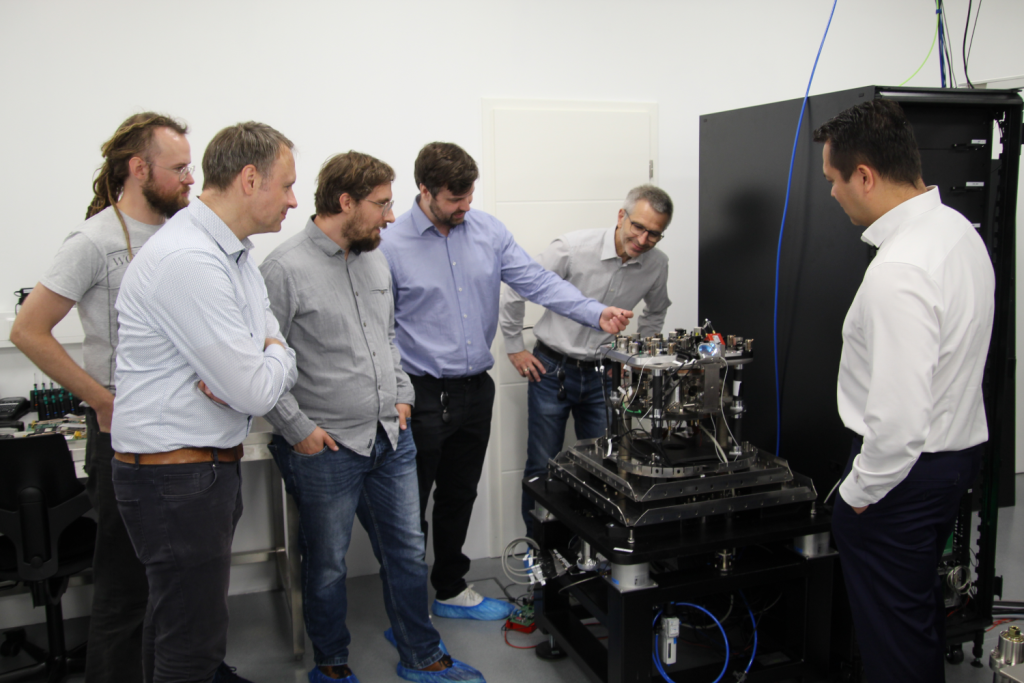
As part of the Mobile Quantum Computer (MQC) program, the Agentur für Innovation in der Cybersicherheit GmbH (Cyberagentur) is commissioning the development of initial demonstrators for future security and defense applications using three technological approaches. A milestone meeting at neQxt in Weiterstadt on August 21, 2026, provided an opportunity to take stock of progress.
Today, quantum computers generally require highly specialized laboratory environments. The research program “Mobile Quantum Computer – Quantum Processors for Mobile Use in Defense and Security Applications (MQC)” by the Agentur für Innovation in der Cybersicherheit GmbH (Cyberagentur) is therefore investigating how quantum computing power can become more compact, robust, energy-efficient, and deployable in the future.
Since 2024, three program partners have been working in parallel on different technological solutions: neQxt GmbH with maQue, Oxford Ionics Limited in collaboration with Infineon Technologies AG on Min-Ion, and Quantum Brilliance GmbH in collaboration with Parity Quantum Computing GmbH on Diamonds-MQC. The Cyberagentur is funding the research with a total of more than 44 million euros.
“At MQC, we don’t just look at the performance of the quantum processors (QPUs). What matters most is the overall system comprising the QPU, control unit, and peripherals. Size, weight, power consumption, robustness, and deployability must be part of the development process from the very beginning. That’s why we’re deliberately exploring different technological paths while adhering to the same overarching requirements,” says Dr. Daniel Gille, acting head of the Key Technologies Department.
Three Technological Approaches
maQue from neQxt is based on ion trap technology. The company is pursuing a full-stack approach and developing hardware and software with the aim of integrating the necessary components into a compact, scalable, and robust system.
Min-Ion, a joint venture between Oxford Ionics and Infineon, also uses trapped ions as qubits. Oxford Ionics is contributing an electronic qubit controller, while Infineon is primarily contributing its expertise in scalable ion trap chips and semiconductor manufacturing. The approach aims to combine high computational performance with a compact system architecture.
In contrast, Quantum Brilliance’s Diamonds-MQC and ParityQC take a solid-state approach using nitrogen vacancies (NV centers) in synthetic diamonds. The elimination of extensive cryogenic cooling offers advantages, particularly in terms of the size, energy consumption, and portability of the overall system.
The various technologies cannot be compared solely on the basis of individual metrics such as the number of controllable qubits. Qubit quality, control, system architecture, energy consumption, required peripherals, and robustness are equally relevant. The MQC research program enables precisely this kind of comparison based on common requirements.
Milestone Event in Weiterstadt
The occasion for the current interim review was a milestone meeting on August 21, 2026, at neQxt in Weiterstadt. There, an initial operational version of maQue was presented. During live operation, the company demonstrated, among other things, gate operations and ion shuttling.
The milestone agreed upon for the project was scheduled for July 31, 2026. neQxt stated: “The Cyberagentur milestone was due on July 31, 2026. We were able to successfully demonstrate that we met the requirements and, in some cases, exceeded them.”
The meeting thus documented the current status of one of the three projects being carried out in parallel. It does not, however, involve a comparative evaluation of the three technological approaches at this time.
The aim of the overall program remains to eventually move quantum computers out of highly specialized laboratory environments. For security and defense applications in particular, it could become important in the long term to make quantum computing power available even in places where stationary data centers or stable data connections are not available.