
Cyberagentur Presents Initial Milestones from Four Research Programs.
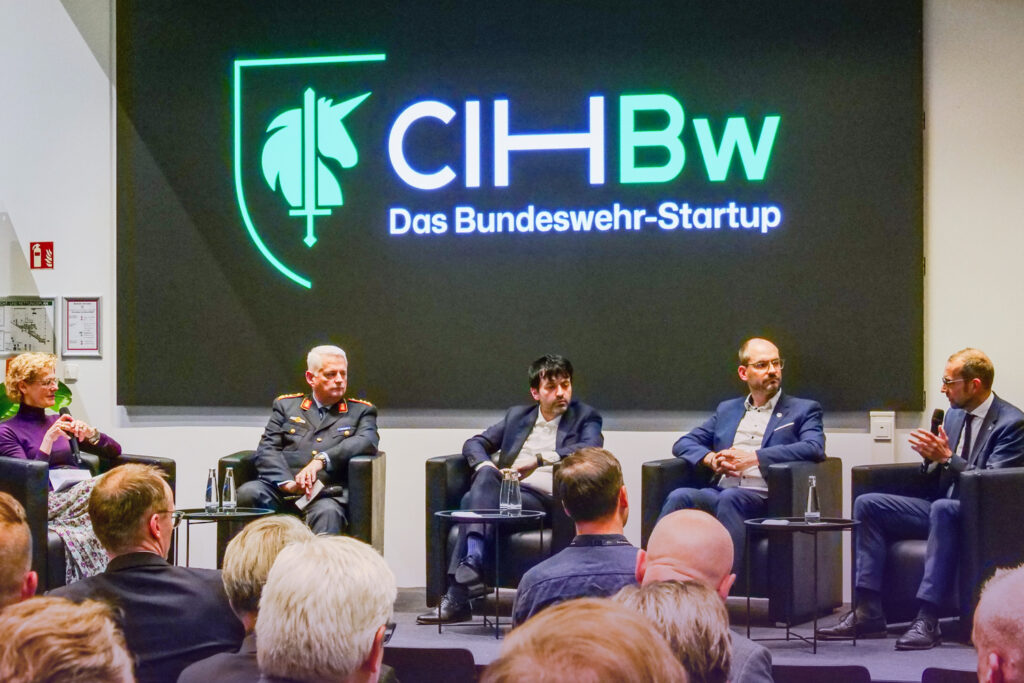
At a side event organized by the Federal Ministry of Defense during the 2026 Digital Summit, the Agentur für Innovation in der Cybersicherheit GmbH (Cyberagentur) presented four research programs together with its project partners. Initial milestones and the current state of technological development in cybersecurity research drew great interest from political guests.
The German federal government’s Digital Summit, held on November 2 and 3, was themed “Shaping AI: safe, sovereign, competitive.” The focus was on the security of artificial intelligence, Europe’s digital sovereignty, and international competitiveness. Among other things, the German government aims to establish Germany as a leading AI hub by 2030. The summit, opened by Federal Minister for Digital Affairs Dr. Karsten Wildberger and attended by Federal Chancellor Friedrich Merz, provided the political framework for the discussions.
The side event “Digital Sovereignty as a Combat Asset—The Digital Battlefield of the Future,” organized by the Federal Ministry of Defense on November 3 at the Bundeswehr’s Cyber Innovation Hub in Berlin, provided an opportunity for discussion among policymakers, academics, security agencies, and technology researchers. During the event, the Cyberagentur and the Cyber Innovation Hub presented their research approaches and initial findings.
Research requires courage and technological foresight
The panel discussion at the event focused on how high-risk research leads to long-term security capabilities. Lieutenant General Michael Vetter, Head of the Innovation and Cyber Division at the Federal Ministry of Defense, emphasized the value of open-ended research: “The great thing about the Cyberagentur is that it can also investigate topics that ultimately turn out to be unfeasible. And yet it’s still a successful innovation project because we’ve tested whether this technology will be relevant in the future.”
“Our job is to keep filling this reservoir—from which the Innovation Hub draws today—even 15 years from now—with innovations and technologies that we have and no one else does,” said Michael Domberg of the Cyberagentur, referring to the different time horizons of research and application: Strategic foresight and the early identification of technological breakthroughs are crucial for this.
Sven Weizenegger, head of the Bundeswehr’s Cyber Innovation Hub, made it clear that scientific progress alone is not enough: “If I don’t enable an organization to adopt these advancements, then we can develop as much as we want here. We’ll still have a problem.” What’s crucial, he said, are structures that enable new technologies to be put into practical use more quickly.
Thomas Röwekamp (CDU/CSU), chairman of the German Bundestag’s Defense Committee, also emphasized Germany’s existing technological capabilities. He made a clear demand regarding their use in security policy: “It is no longer a question of whether we can do it. It really comes down to whether we want to.”
The discussion, moderated by Nana Brink, head of the “Security & Defense” editorial team at Tagesspiegel Background, thus highlighted the complementary roles of long-term security research, rapid technology integration, and policy-making. The Cyberagentur’s research milestones presented at the Digital Summit demonstrated how these areas can interlock.
Research Findings for Digital Sovereignty
Through four research programs, the Cyberagentur demonstrated how long-term, high-risk research can make concrete contributions to Germany’s technological capacity for action and security.
Mobile Quantum Computer (MQC): The research partners are developing quantum computers that could be used in the future without relying on specialized laboratory environments. neQxt publicly unveiled a model of its “maQue” system for the first time. As early as August 2026, the company had demonstrated an initial functional version of the system. At the same time, Oxford Ionics was collaborating with Infineon Technologies, and Quantum Brilliance was working with Parity Quantum Computing on additional technological approaches.
BCI – Secure Brain-Computer Interfaces: As part of the NAFAS research project, Zander Laboratories is developing non-invasive neurotechnological systems for tracking mental states and enabling adaptive human-machine interaction. Key requirements include data security, transparency, and control over personal brain data.
HEGEMON – Security of Generative AI: This research program investigates how generative AI models can be reliably evaluated and compared in safety-critical applications. To this end, DFKI, GAF, dida Datenschmiede, Fraunhofer IIS, and InfAI are developing scientific testing methods and customized AI models. The focus is on applications involving geoinformation data.
AuBi – Secure Digital Identities: Bundesdruckerei, neXenio, and the University of Potsdam are researching new biometric authentication methods. Among other things, the “Self-ID” project is investigating how individual reactions to recognizing one’s own face can be used for secure identity verification.
Further information and submissions:
www.cyberagentur.de/programme/