
Call for proposals for the DDK research programme: Reducing data, reliably reconstructing media content
On 16 March 2026, the Agency for Innovation in Cybersecurity GmbH (Cyber Agency) published the call for proposals for the research programme “Data reconstruction following selective data reduction in challenging communication environments with a focus on image and sound” (DDK). The call seeks research and development approaches that specifically reduce video, image and audio, transmit them securely even with minimal bandwidth and subsequently reconstruct them reliably – without distorting mission-critical content.
With the publication of the call for proposals on 16 March 2026, the Cyber Agency is launching a new research programme. DDK will focus on technologies and approaches that process image, video and audio data in such a way that they remain reliably usable despite communication with minimal and potentially unreliable transmission rates. The data is to be specifically reduced prior to transmission and then restored or upscaled on the receiving end using modern methods. It is particularly important that mission-critical content is automatically recognised and remains unaltered during transmission. It must also be considered that the procedures required for this will increase the demand for resources such as energy and computing power, which are also extremely limited in operational and disaster scenarios. Accordingly, the issue of optimal resource allocation must be addressed simultaneously in order to ensure the best possible transmission quality even with scarce resources.
By the end of the programme, practical solutions, which can already be demonstrated, tested and evaluated in demonstrators, have to be presented, thereby achieving a technology readiness level (TRL) of 4. Through this, the Cyber Agency aims to tangibly improve the communication capabilities of internal and external security actors in the field – particularly where bandwidth is scarce yet a reliable situational picture and robust decision-making are required. In terms of content, DDK focuses primarily on techniques from the fields of machine learning and deep learning, as well as methods of media processing and AI upscaling. In addition, the project promotes a sustainable professional exchange in which researchers from these fields can network.
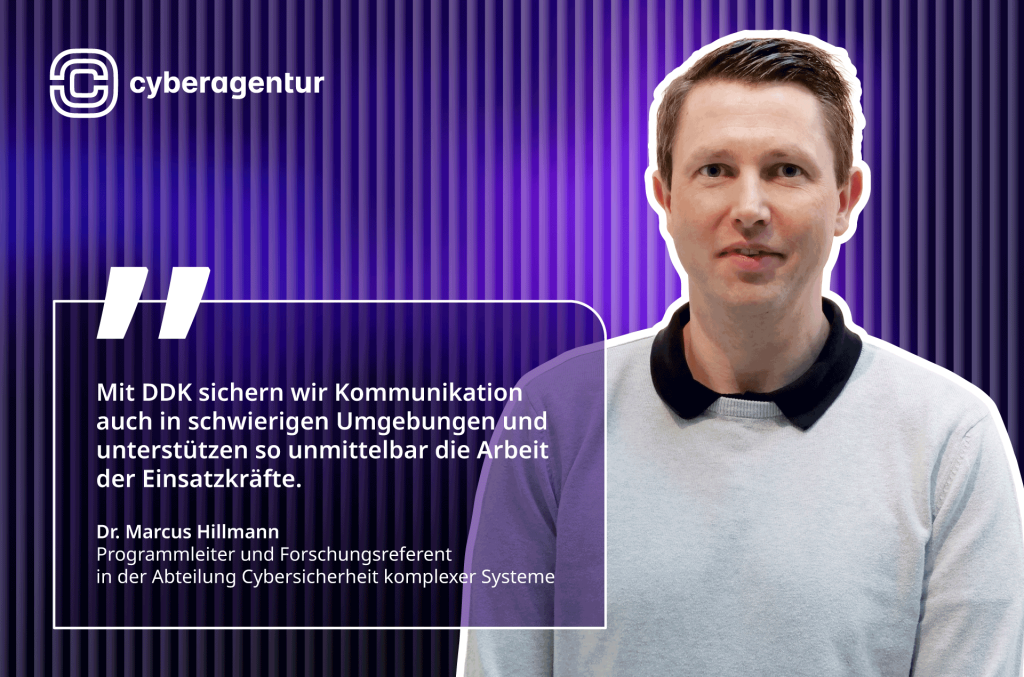
“When communication becomes unreliable or even fails completely in critical situations, this poses an acute threat to the health and lives of those involved,” says Dr Marcus Hillmann, Programme Manager and Research Officer in the Department of Cybersecurity of Complex Systems. “DDK addresses precisely this gap: we aim to advance communication technologies in such a way that content can be transmitted even under adverse conditions whilst remaining reliable.”
In the DDK research programme, the Cyber Agency is using Public Procurement of Innovative Solutions (PPI) for the first time to bring successful research results to market as early as possible, in collaboration with end-users. The aim is to accelerate the transfer to practical application and make effective approaches available more quickly.
Subsequent, potential serial production also secures jobs, as the public end-user, being the first purchaser, secures revenue whilst simultaneously benefiting from innovations.
The requirements are formulated in functional terms; the demonstrable performance of the solution is decisive. Selection takes place through a competitive process in which contractors must demonstrate implementation, security and performance.
This is preceded by a pre-selection competition, followed by three phases: a remunerated concept development phase (up to four participants), a three-year solution exploration phase, and a one-year solution testing phase (up to two contractors in each). Selection decisions are made by a jury comprising staff from the Cyber Agency and external experts.
With this call for proposals, the Cyber Agency is targeting capable applicants and consortia from academia and industry – in particular research institutions, companies and consortia with proven expertise in AI-supported media processing and secure communication. In particular, established businesses or start-ups should also apply, either alone or in partnership with others, if they wish to develop and offer a marketable product based on the research and development results. The aim is to identify excellent approaches, further develop them through competition and demonstrate their technological robustness in a security context.
The call for proposals, with the contract notice number TED 188421-2026 (https://ted.europa.eu/de/notice/-/detail/188421-2026), was published in the Supplement to the Official Journal of the European Union. The deadline for submitting applications is May 21, 2026, at 2:00 p.m. Interested research institutions and companies may express their interest in participating immediately. Participation is possible both individually and as part of a consortium.
Further information: