
New Location Boosts Research in Dresden’s Technology Ecosystem
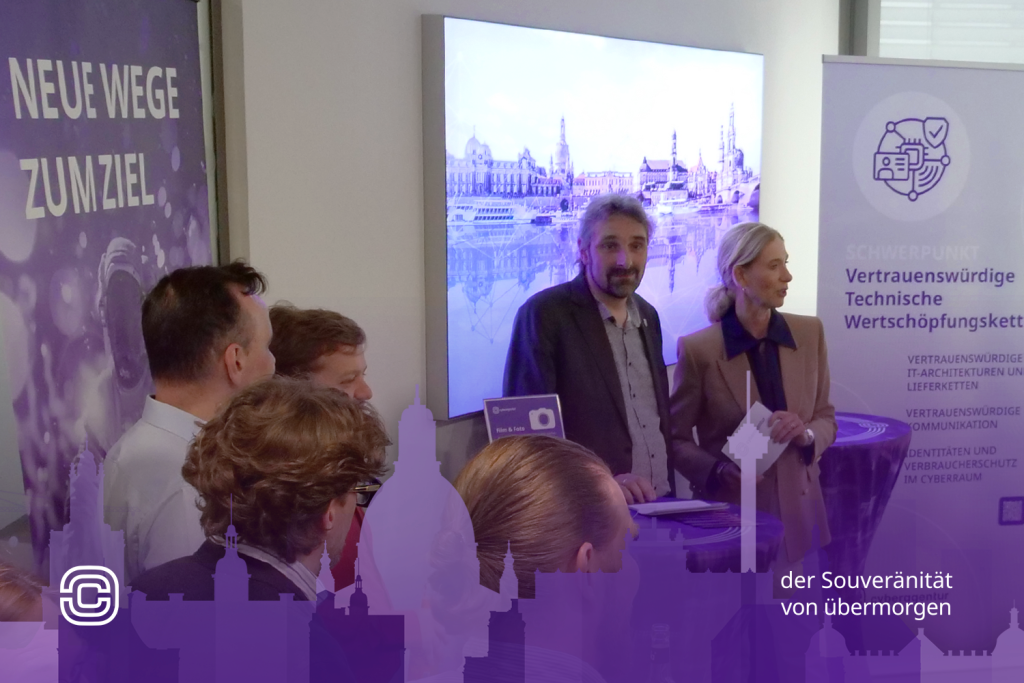
The Agentur für Innovation in der Cybersicherheit GmbH (Cyberagentur) officially opened its project office in Dresden on June 18, 2026. The location centralizes work on trustworthy technical value chains and connects the agency more closely with Dresden’s research and technology ecosystem.
On Thursday, the Cyberagentur officially opened the new offices of its Dresden project office. The event was attended by guests from the worlds of politics, business, academia, and government agencies. Among those represented were the head of the Saxon State Ministry of the Interior and other representatives from Saxon ministries, the BSI in Freital, the Technical University of Dresden, the Dresden University of Applied Sciences, Mittweida University of Applied Sciences, and local research institutes: Silicon Saxony was also represented, and major chip manufacturers, as well as companies with high research potential in the fields of cybersecurity, communications, and hardware and software development, made their way to the project office.
Dresden was a deliberate choice of location for the Cyberagentur. As a hub for technology and semiconductors, it creates an environment where research, industrial applications, talent, and established networks come together directly. It is precisely this environment that is of strategic importance for cybersecurity issues.
“For us, Dresden isn’t just a development project. This location is an invitation to dialogue and collaboration in pursuit of technological sovereignty,” says Bettina Bubnys, commercial managing director of the Cyberagentur. “For cutting-edge research to be effective, it requires robust structures: reliable processes, a secure working environment, clear responsibilities, and proximity to strong partners. All of this comes together at the Dresden project office.”
With this opening, the Cyberagentur’s “Trustworthy Technical Value Chains” department will have a central office in Dresden. The department’s work focuses on the question of how digital solutions can be designed to be trustworthy from start to finish. After all, trust in digital systems does not arise only when they are used. It begins with raw materials, extends to hardware and software as well as the associated architecture and communication between systems, and ultimately ends with the user—and thus with issues of digital identity and consumer protection.
The department focuses on three key areas: trustworthy IT architectures and supply chains. The focus is on verifiably secure IT products and sustainably secured supply chains. The second-largest research program, the Trusted IT Ecosystem (ÖvIT), is firmly anchored here. In addition, the department in Dresden is responsible for trusted communication. Networked systems must not only be high-performance but also secure and capable of communicating without interruption. The department also addresses identities and consumer protection in cyberspace. The aim is to develop digital services that protect identities, create transparency, and strengthen citizens’ digital vigilance.
These topics are not addressed in isolation. They are closely linked to the Cyberagentur’s other departments. Trustworthy value chains involve issues related to complex systems, secure societies, and key technologies. Hardware, software, communication, user behavior, and societal acceptance cannot be viewed in isolation from one another. That is why the Cyberagentur also relies on interdisciplinary collaboration in Dresden.
“Trustworthy technical value chains are not a peripheral issue in cybersecurity. They are one of its fundamental prerequisites,” says Prof. Dr. Christian Hummert, Research Director and Managing Director of the Cyberagentur. “A system is only as secure as the components it consists of, and only as trustworthy as the chain that produces those components.”
The Dresden Project Office was established on June 1, 2024. Initially, the team operated as a small start-up team. With the official opening of the new office space, the start-up phase has been completed from an organizational standpoint, and the office is now firmly established within Dresden’s technology and research community.
The opening thus represents a strategic step forward for the Cyberagentur. It strengthens the agency’s presence in one of Europe’s most important locations—or regions—for microelectronics, semiconductor technology, IT security, mobile communications, and applied research in these fields. At the same time, it creates additional opportunities for exchange, cooperation, and long-term research on issues of digital sovereignty.