
Call for Proposals for InSuReCS Launched
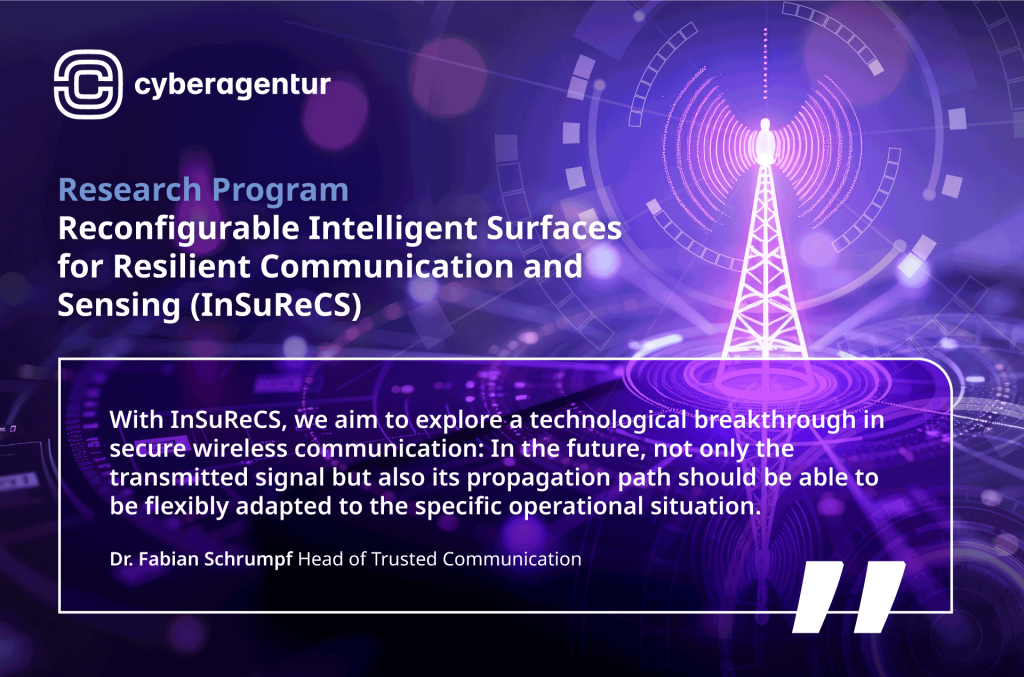
On August 27, 2026, the Agentur für Innovation in der Cybersicherheit GmbH (Cyberagentur) published the call for proposals for the research program “Reconfigurable Intelligent Surfaces for Resilient Communication and Sensing (InSuReCS).” The Agentur is seeking innovative research approaches for adaptively controllable metasurfaces designed to enable resilient communication and reconnaissance in highly mobile operational scenarios. Applications are accepted through October 27, 2026.
Wireless radio communication is indispensable for mobile forces. At the same time, it can be detected, jammed, or used by the enemy for electronic warfare for example to locate friendly forces. Modern cryptographic methods protect the transmitted information. However, they do not prevent radio transmissions from being detected or their sources from being located. Protecting one’s own electromagnetic signature is therefore a crucial operational component of communications security (COMSEC).
Technical and tactical measures such as frequency hopping, burst transmissions, microwave links, short transmission cycles, or high mobility already reduce this risk today and are standard practice. However, they can limit the range, flexibility, and availability of communications. At the same time, the demand for broadband and resilient data connections is growing. This applies in particular to tactical data links, networked sensor systems, and continuously updated situational awareness in the “Military Internet of Things.”
This is where InSuReCS comes in. The research program aims to develop an adaptively controllable transmission and reception technology based on intelligent metasurfaces. The focus is on so-called Reconfigurable Intelligent Surfaces (RIS). These technically reconfigurable surfaces can selectively influence electromagnetic signals and thereby alter their propagation path.
“With InSuReCS, we aim to explore a technological leap forward in secure radio communication: In the future, not only the transmitted signal but also its propagation path should be flexibly adaptable to the respective operational situation. If we succeed in harnessing intelligent metasurfaces for this purpose, they can make an important contribution to making communication more resilient while simultaneously reducing the detectability of our own forces,” explains Dr. Fabian Schrumpf, Head of Trustworthy Communication at the Cyberagentur.
The aim is therefore to enable communication and reconnaissance not exclusively via direct radio links between transmitter and receiver. Instead, signals are to be specifically relayed via suitable intermediate or relay stations. In this way, transmission paths are to be dynamically adapted to the respective situation, and the ability to locate friendly forces based on their radio communications is to be reduced.
The technology to be developed is intended to complement existing radio technology and expand its capabilities – for example, in terms of bandwidth, frequency range, and directional characteristics. At the same time, InSuReCS is focusing on future communication applications. Of particular interest is the integration of communication and sensor technology in the context of Integrated Communication and Sensing (ISAC). In this context, radio signals can be used not only for data transmission but also for active and passive reconnaissance and sensor tasks.
Risk Research with a Focus on 6G Technologies
InSuReCS is designed as disruptive risk research. Intelligent metasurfaces are already being investigated with a view to future generations of mobile communications such as 6G – albeit in a static environment. The Cyberagentur intends to commission research to determine whether and how this technology can be adapted for highly dynamic conflict and crisis management scenarios.
Key research objectives include largely platform-independent deployability, integration into existing and future radio applications, and the continuous adaptation of the RIS configuration in highly mobile operational scenarios. If successful, mobile response teams will benefit from broadband, resilient, and secure communication and remote reconnaissance with high directivity.
The research program falls under the thematic area of Trustworthy Technical Value Chains. With this call for proposals, the Cyberagentur is specifically targeting research institutions, universities, and companies with expertise in areas such as radio and communications engineering, high-frequency technology, metasurfaces, antenna technology, sensor technology, software-defined radio, and communications and information technology.
The call for entries was published on E-Vergabe-Online.de, amongst other sites: https://www.evergabe-online.de/tenderdetails.html?3&id=885697. The deadline for expressions of interest is 28 October 2026 at 10.00. Interested research institutions, companies and start-ups may express their interest with immediate effect. Participation is possible either individually or as part of a consortium.