
Cybersecurity research with an impact on defense capability and technological sovereignty
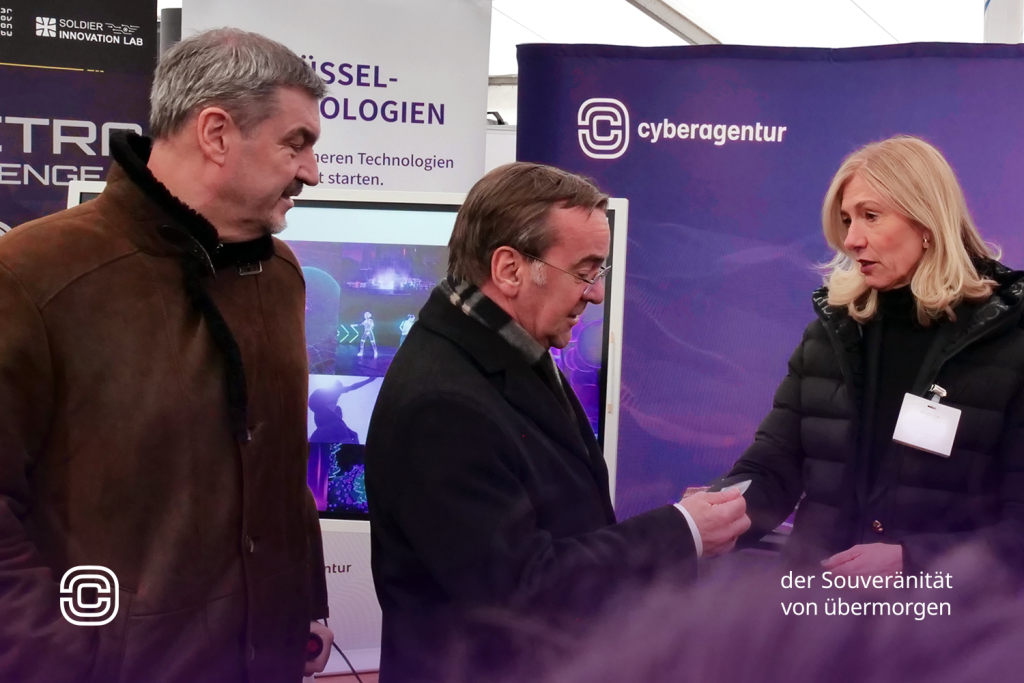
On February 2, 2026, Federal Minister of Defence Boris Pistorius and Bavarian Prime Minister Markus Söder opened the Bundeswehr Innovation Centre at the former Erding Air Base. The new location marked an important step towards more application-oriented security and defense research. The Agentur für Innovation in der Cybersicherheit GmbH (Cyberagentur) used the ceremony to position itself as a mediator in the innovation ecosystem that contributes to the technological sovereignty of the Federal Republic of Germany between research, industry and users.
With the opening of the Bundeswehr Innovation Center at Erding Air Base on 2 February 2026, the Bundeswehr sent a clear signal for the innovation-driven further development of its capabilities. Federal Minister of Defense Boris Pistorius opened the site: Quote: “This is where the Bundeswehr and science, research and industry, start-ups and established companies of all sizes meet. […] However, it is also clear that the Bundeswehr will continue to open up. We will target technology clusters […]. Small and medium-sized enterprises and start-ups will then have new opportunities for exchange, project participation and competition for fresh ideas.”
Erding will thus become a place where innovation processes are accelerated and research issues are more closely interlinked with practical requirements: “The Cyber Innovation Hub and the Cyberagentur will also be represented here with elements and their experience will promote exchange in the sense of a real innovation ecosystem. And in this ecosystem, what belongs together should grow together […] and interact with each other in natural symbiosis,” said Defense Minister Boris Pistorius, explaining the role of the Cyberagentur. Future threats would develop dynamically, and traditional development cycles would be too short. Application-oriented research that considers future use at an early stage will therefore become a strategic factor for Germany’s defense capability.
Bavarian Minister President Markus Söder then addressed the guests. The new location is geared towards testing technological developments at an early stage and consistently aligning them with operational requirements. “And that is why this center today […] is a ray of hope. It connects technology, it connects innovation, it connects the Bundeswehr.”
The Cyberagentur made a targeted contribution to this context as part of the opening. Its approach of structuring sophisticated research programs along real needs aims to produce findings and technologies that can be used for both military and civilian purposes. The dual-use concept is not a side effect, but a guiding principle: “Research questions are formulated in such a way,” said Commercial Director Bettina Bubnys in conversation with Minister Pistorius, “that they enable cross-departmental synergies and at the same time develop a concrete benefit for the Bundeswehr.” Close dialog with the Bundeswehr as a user is crucial in order to effectively transfer research results into application.
In this context, Bettina Bubnys briefly referred to the Cyberagentur’s plans for a liaison office in Erding. This is intended as an accompanying instrument to further intensify cooperation with the Bundeswehr and to strengthen the Cyberagentur’s role as a mediator between science, industry, authorities and state actors. The aim is to identify application-related research questions at an early stage and accelerate the transfer of ideas into use.
With the information stand and a virtual tour of selected research programmes, the Cyberagentur provided insights into its work and illustrated how cyber security research is organized along concrete needs. The opening of the innovation center in Erding thus underlined the claim that innovation is not an end in itself, but a contribution to the technological sovereignty and long-term security provision of the Federal Republic of Germany.