
Network meeting sparks discussion on the “Vision for the Police in 2040.”
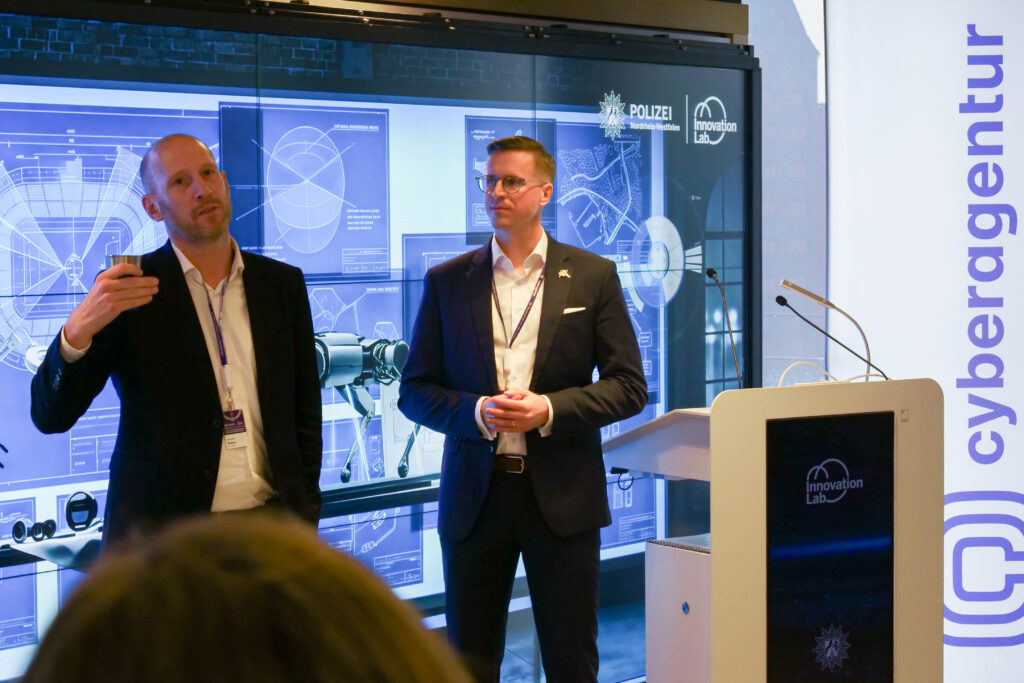
On November 17 and 18, the network meeting of Germany’s police innovation labs took place at the North Rhine-Westphalia Police Innovation Lab in Duisburg. The Agentur für Innovation in der Cybersicherheit GmbH (Cyberagentur) and the North Rhine-Westphalia Police Innovation Lab, together with the participants, developed the “Vision for the Police in 2040” based on a fictional scenario set against the backdrop of the 2040 Olympics in North Rhine-Westphalia.
How must the police be able to respond to complex threat scenarios in 2040? What role do robotics, artificial intelligence, and the intelligent integration of large amounts of data play in this? And what innovations must be developed today to ensure that the necessary capabilities are available in time? The innovation units of Germany’s police forces and intelligence services addressed these questions during their two-day networking meeting. The focus was on cybersecurity and the protection of the public under the technological conditions of the year 2040.
At the opening, Dominic Reese, head of the North Rhine-Westphalia Police Innovation Lab, emphasized the importance of collaborative innovation efforts: “The police in Germany are great. 84 percent of the population trusts the police. Everything we do here is essential to ensuring that the police remain socially relevant in the future.”
Olympics 2040: The Security Landscape of the Future
The network meeting began with a fictional future scenario: In 2040, Duisburg is set to host the Olympic Games. Millions of visitors, international delegations, and athletes will encounter an increasingly interconnected infrastructure. At the same time, security authorities are confronted with complex threats. Cyberattacks, manipulated information, and new technological dependencies make it difficult to assess the security situation.
Across three thematic tracks, participants explored how robotics, agent-based artificial intelligence, as well as open-source intelligence (OSINT), big data, and data fusion could transform police work. Agent-based AI refers to systems that can plan and execute tasks largely on their own. OSINT describes the systematic collection and analysis of information from publicly available sources.
Methodologically, the groups worked in what are known as Red and Blue Teams. While the Red Teams identified potential attack strategies, manipulations, and vulnerabilities, the Blue Teams developed the capabilities a police force would need in the year 2040. The different perspectives were then brought together and synthesized into a shared vision of the future.
In particular, it became clear that in the future, the police will need more than just more powerful technologies. They must also be able to reliably evaluate large amounts of information, detect manipulated data, and use complex technical systems safely. The reliability of digital information and the ability to make sound decisions based on it are key prerequisites for this.
From the 2040 Olympics Back to the Present
On the second day of the event, the participants deliberately shifted their perspective. After having outlined the “Vision for the Police in 2040” the previous day, the focus now turned to the question of which innovations must be initiated today in order to overcome the identified challenges in the future.
To do this, the groups used the backcasting method. This involved starting with the future state they had developed the previous day and working backward step by step to the present. This approach makes it possible to identify necessary technological developments, organizational changes, and strategic decisions.
Using potential milestones for the years 2030 and 2035 as a starting point, the participants discussed what capabilities the police must develop on the path toward 2040. The discussion focused not only on new technical systems, but also on changes in processes, regulatory frameworks, and collaboration between law enforcement agencies, academia, and the technology sector.
Based on these future scenarios, specific research questions and potential approaches for joint innovation projects were derived. It was crucial not to view technological solutions in isolation, but rather to develop them based on the actual requirements of future police work.
Combining Police Practice with Long-Term Cybersecurity Research
For the Cyberagentur, collaboration with police innovation labs serves as a crucial foundation for identifying future challenges to internal security at an early stage. The practical experience of law enforcement agencies makes it possible to evaluate technological developments and potential capability gaps from various perspectives.
As part of its research programs, the Cyberagentur examines technological issues with a time horizon of ten to fifteen years. It is precisely this long-term approach that makes it possible to identify research needs before new threats directly impair the police’s ability to act.
The network meeting also made it clear that cybersecurity and civil protection will be even more closely intertwined by 2040. Automated systems, data-driven decisions, and digitally connected infrastructures open up new possibilities for police work. At the same time, they create dependencies and vulnerabilities that must be taken into account as early as the development stage of these technologies.
The joint “Vision for the Police in 2040” is therefore not merely an exploration of potential security scenarios for the distant future. It also serves as a starting point for identifying today’s research and innovation needs and for further developing collaboration among police innovation units.
The key insight from the network meeting: Anyone who wants to ensure public safety in 2040 must develop the necessary capabilities and technologies today.